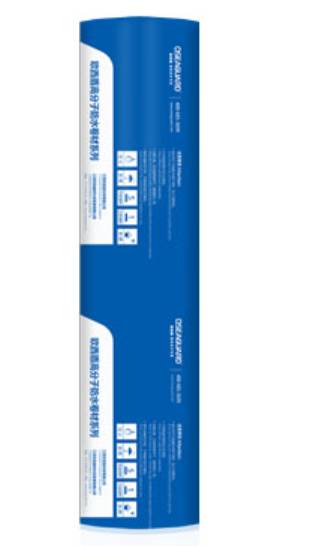

Essential details
Shipping:Express delivery
Product Introduction
HYQ®-100 Non-Bituminous Polymer Self-Adhesive Waterproofing Membrane is a novel polymer waterproofing material manufactured by thermally laminating a modified high-density polyethylene (HDPE) substrate with a non-bituminous polymer self-adhesive layer. Its isolation layer is composed of specialized sand granules or an aging-resistant polyethylene-silicone oil film. This product complies with the requirements for the "Pre-laid Type P" category specified in the standard GB/T 23457-2017, *Pre-laid Waterproofing Membranes*.
**Product Features**
* **Reverse Bonding:** Bonds in reverse to the structural layer; unaffected by settlement of the cushion layer. It creates a gap-free interface between the waterproofing layer and the concrete structure, thereby completely eliminating water channeling.
* **Single-Layer Efficacy:** A single layer is sufficient to meet the Grade I waterproofing requirements for underground projects, eliminating the need for a separate protective layer and potentially reducing overall project costs by up to 30%.
* **Lightweight and Flexible:** Utilizes modified raw materials as its substrate, resulting in a lightweight and flexible material that facilitates easy transportation and installation.
* **Exceptional Durability:** Exhibits superior chemical stability and corrosion resistance, along with high resistance to nail punctures and tearing.
* **Self-Healing Properties:** Features a pressure-sensitive self-adhesive layer with strong self-healing capabilities.
* **Comprehensive System Support:** Supported by a full range of specialized accessory materials, ensuring a fast and simple installation process.
* **Impact and Puncture Resistance:** Demonstrates excellent resistance to impact and puncture, capable of withstanding direct construction loads and the impact of steel reinforcement cages without the need for an additional protective layer.
**Scope of Application
Primarily used in waterproofing projects for basements, integrated utility tunnels, subway tunnels, and similar underground structures.
**Construction Methods and Process**
**Construction Process Flow:**
Base surface cleaning → Positioning and line marking → Membrane pre-laying → Lap joint treatment → Detail/node treatment → Steel reinforcement tying → Concrete pouring.
Base surface cleaning → Positioning and line marking → Membrane pre-laying → Lap joint treatment → Detail/node treatment → Steel reinforcement tying → Concrete pouring.
**Construction Method:**
* **Membrane Pre-laying:** Measure and cut the product to size. Lay the membrane with its self-adhesive release paper facing the intended structural layer (and the non-adhesive side facing the base surface). Pre-lay the membrane over the cushion layer, protective wall, underground continuous wall, or pile wall.
* **Membrane Jointing:** Membrane joints are sealed using a cold self-adhesive method. For longitudinal joints, simply peel off the release film from the designated self-adhesive overlap edge and press to bond directly. For transverse joints, utilize specialized lap joint tape to create a fully sealed waterproofing system.
* **Membrane Pre-laying:** Measure and cut the product to size. Lay the membrane with its self-adhesive release paper facing the intended structural layer (and the non-adhesive side facing the base surface). Pre-lay the membrane over the cushion layer, protective wall, underground continuous wall, or pile wall.
* **Membrane Jointing:** Membrane joints are sealed using a cold self-adhesive method. For longitudinal joints, simply peel off the release film from the designated self-adhesive overlap edge and press to bond directly. For transverse joints, utilize specialized lap joint tape to create a fully sealed waterproofing system.
**Storage and Transportation**
During storage and transportation, products of different types and specifications must be stacked separately and should not be mixed together. Avoid exposure to direct sunlight and rain, and ensure adequate ventilation. Storage temperatures must not exceed 45°C. When stored horizontally, stacking height should not exceed five layers; when stored vertically, items must be stacked in a single layer. Contact with acids, alkalis, oils, organic solvents, and similar substances is strictly prohibited. During transport, prevent tilting or lateral compression; cover with a tarpaulin if necessary.
Product Specifications:
| specification | thickness(mm) | width(m) | length(m) |
| HDPE | 1.2 1.5 1.7 | 1.0 2.0 | 20 |