
Essential details
Shipping:express delivery
Product Introduction
Long-filament Woven Geotextile
Product Introduction:Long-filament woven geotextiles possess high strength, low elongation, durability, and corrosion resistance; they can meet the requirements of various geotechnical engineering applications such as filtration, isolation, reinforcement, and protection. To ensure the stability and balance of the product structure and the compliance rate of engineering parameters...
Performance Characteristics:
1. High Strength: Using high-strength industrial-grade polypropylene, polyester, nylon, and other synthetic fibers as raw materials, it has high initial strength. After weaving, it forms a regular interwoven structure, further improving the overall load-bearing capacity.
2. Durability: Synthetic fibers are characterized by their resistance to deformation, decomposition, and weathering, effectively maintaining their original properties.
3. Corrosion Resistance: Synthetic fibers generally possess resistance to acids, alkalis, insects, and mildew.
4. Permeability: The woven fabric can effectively control its structural porosity to achieve a certain degree of permeability.
5. Convenient Storage and Transportation: Due to its lightweight nature and ability to be packaged according to specific requirements, transportation, storage, and construction are all very convenient.
Applications: A series of industrial geotextile materials adapted to various characteristics and requirements of geotechnical engineering. Widely used in rivers, coastlines, harbors, highways, railways, docks, etc.
Polyester Geotextile
Functions of Geotextile:
Functions of Geotextile:
1. Isolation: Polyester staple fiber needle-punched geotextile isolates building materials with different physical properties (particle size, distribution, consistency, and density, etc.) (such as soil and sand, soil and concrete). This prevents the loss and mixing of two or more materials, maintaining the overall structure and function of the materials and strengthening the load-bearing capacity of the structure.
2. Filtration (Reverse Filtration): When water flows from a fine-grained soil layer to a coarse-grained soil layer, the good air and water permeability of polyester staple fiber needle-punched geotextile allows water to flow through while effectively intercepting soil particles, fine sand, small stones, etc., to maintain the stability of the soil and water engineering.
3. Drainage: Polyester staple fiber needle-punched geotextile has excellent water conductivity, forming drainage channels within the soil to expel excess liquid and gas from the soil structure.
4. Reinforcement: Polyester staple fiber needle-punched geotextile enhances the tensile strength and deformation resistance of the soil, improving the stability of building structures and thus improving soil quality.
5. Protection: When water flows over the soil, it effectively diffuses, transfers, or decomposes concentrated stress, preventing soil damage from external forces and protecting the soil.
6. Puncture Resistance: Combined with geomembranes, it forms a composite waterproof and seepage-proof material, providing puncture resistance.
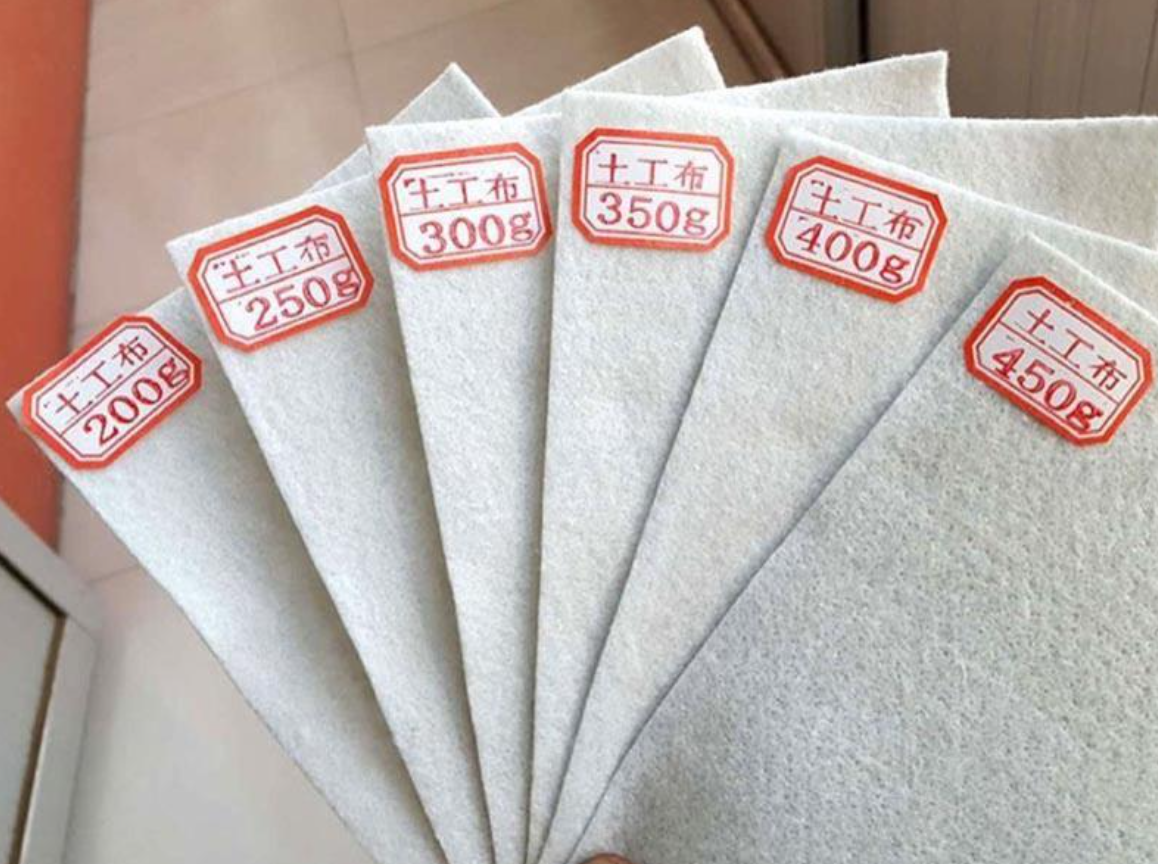
Geometex Fabric Introduction: Geotextile, commonly known as short-fiber geotextile, is a permeable geosynthetic material made of synthetic fibers through needle punching or weaving. The finished product is fabric-like, typically 1-6 meters wide and 50-100 meters long. Short-fiber geotextile possesses excellent mechanical properties, good permeability, and is resistant to corrosion and aging. It functions as a separator, filter, drain, protector, stabilizer, and reinforcement, adapting to uneven base layers, resisting construction damage, exhibiting low creep, and maintaining its original functionality under long-term loads.
Performance Characteristics: Good flexibility, easy construction, and excellent permeability, filtration, and separator properties.
Applications:Used for separator, separator, drainage, and maintenance in highway, railway, dam, and reclamation projects.
Product Specifications: 100g/㎡~800g/㎡
Packaging Specifications: Width 1m-6m; Length 50m-100m (can also be customized)
Packaging Specifications: Width 1m-6m; Length 50m-100m (can also be customized)
Geotextile Features:
1. High tensile strength: Due to the use of polyester chips as raw material, it maintains high strength in both dry and wet conditions.
1. High tensile strength: Due to the use of polyester chips as raw material, it maintains high strength in both dry and wet conditions.
2. Resistant to acid and alkali corrosion: It maintains its original physical properties in soil and water with varying pH levels.
3. High permeability coefficient: Due to its needle-punched nonwoven manufacturing process, it possesses excellent water permeability and soil and water conservation properties.
4. Antimicrobial: It is unaffected by microorganisms and insect infestation.
5. Easy construction: Due to its lightweight and flexible material, it is convenient to transport, lay, and construct.
Functions:
1. Isolation: It can be used as an isolation layer. Suitable for saline-alkali swamps and landfills.
1. Isolation: It can be used as an isolation layer. Suitable for saline-alkali swamps and landfills.
2. Filtration: Due to its high permeability coefficient and good water permeability, it is widely used in agricultural irrigation, drainage filtration, and other projects.
3. Maintenance: Due to its soil and water conservation properties, it is often used in road maintenance, agricultural planting, and riverbank protection projects.
4. Reinforcement: Due to its high tensile strength, it is often used in roadbed and dam construction projects.
5. Drainage and diversion: Used in projects such as tunnel drainage, underground parking garages, airport construction, and roof gardens.
Short-fiber geotextile
Product Introduction: Geotextile, commonly referred to as short-fiber geotextile, is a permeable geosynthetic material made of synthetic fibers through needle punching or weaving. The finished product is in the form of a fabric. Short-fiber geotextile possesses excellent mechanical properties, good permeability, and is resistant to corrosion and aging. It provides functions such as isolation, filtration, drainage, protection, stabilization, and reinforcement. It can adapt to uneven base layers, resist damage from construction forces, exhibits low creep, and maintains its original functions under long-term loads.
Performance Characteristics:Good flexibility, easy construction, and excellent permeability, filtration, and isolation performance.
Applications: Used for filtration, isolation, drainage, and maintenance in highway, railway, dam, and reclamation projects.